How to Report a Study Abroad Scammer in Nigeria: A Practical Guide
Protect your family's hard-earned tuition funds. Learn how to report a study abroad scammer in Nigeria, spot common advance-fee scams, and make direct payments safely.
August 22, 2026
10 min read
Dhub Editorial
Short answer: To report a study abroad scammer in Nigeria, visit efccnigeria.org and use the 'Report a Crime' section, call the EFCC toll-free line, email info@efcc.gov.ng, or visit any EFCC zonal office with your transaction receipts, communication records, and identifying details of the scammer. If travel exploitation occurred, file a parallel report with NAPTIP.
The short version
Never pay tuition or visa fees into an agent's personal or local bank account.
Verify every admission letter by contacting the foreign university's finance office directly.
File reports immediately with the EFCC and notify your bank's fraud department if scammed.
Use official, encrypted payment portals like Flywire specified on the school's website.
The New Landscape of Tuition Fraud in Nigeria
Securing admission to a foreign university is a milestone of immense pride for Nigerian families, but it is also a moment when parents are highly vulnerable. Sceptical and practical parents must navigate an increasingly complex environment. Cybercrime has risen sharply within the country; the Economic and Financial Crimes Commission (EFCC) reports a high incidence of internet fraud among Nigerian undergraduates, with some higher institutions gradually turning into hubs for fraudulent activities. When families attempt to fund their children's education abroad, they are frequently targeted by bad actors posing as educational consultants. Knowing exactly how to report a study abroad scammer in Nigeria is the first line of defence for protecting your family's assets. To understand how to vet these intermediaries before any money changes hands, you can read our parent's guide to protecting tuition payments.
The Mechanics of the Advance-Fee Scam
Most study-abroad scams operate as a classic advance-fee scam, where the victim is enticed to pay significant upfront fees under the false promise of a much larger return—in this case, a guaranteed visa, an unverified scholarship, or a pre-arranged job. Fraudulent agents often exploit a family's urgency by presenting forged documents such as transcripts, offer letters, or bank statements. These forged papers can lead to devastating visa fraud charges and arrests for the student. Some dishonest agents also charge hidden fees for services that should be free, or push specific schools solely to secure commissions. Note that while some legitimate agencies receive commissions from universities, you should always ask any agent—including Dhub Education—to provide their fee structure in writing before making any payment. Never assume any agent's services are entirely free. To audit your consultant's credentials, we recommend using our one-afternoon safety checklist.
Tuition Payment Comparison: Official Portals vs Unverified Agents
Payment Aspect
Official Direct Payment
Unverified Third-Party Agent
Payment Destination
Direct to university's official bank account or verified portal (e.g., Flywire)
Private or local agent accounts not listed on the school's website
Security Measures
Utilises HTTPS secure websites and two-factor authentication (2FA)
Lacks encryption; often requests sensitive details via email or social media
Receipt Verification
Official payment receipt sent directly from the university's finance portal
Manual, easily forged receipts with unverified stamps
Compliance Checks
Adheres to anti-money laundering (AML) laws and OFAC sanctions screening
No regulatory oversight; prone to card fraud or hidden fees
Legitimate advisers will always guide you to make payments directly to the university.
Direct Tuition Payments: Bypassing the Intermediaries
A Benin City mother catches a fraudulent agent's fake Canadian admission letter just hours before a high-pressure local transfer deadline.
Mrs. Mercy Igbinovia — Mother and high school principal in Benin City
Osas Igbinovia — Son and aspiring Canadian college student
Efe Nwosu — Dhub Education counsellor in Benin City
The Midnight Notification
Mrs. Igbinovia receives a high-pressure midnight WhatsApp message demanding an immediate tuition transfer.
Mrs. Mercy Igbinovia stared at her phone as the generator outside hummed its familiar, low rumble. The WhatsApp notification light on her phone pulsed in the dark living room, casting a soft green glow on the dining table where cold jollof rice sat untouched in a plastic bowl. It was 11:45 PM, but the agent, Mr. Felix, had sent three urgent messages in a row.
He claimed that the Canadian college in Ontario had suddenly slashed their tuition deposit by 15% for international students, but only if they paid the Naira equivalent into his personal local account before noon the next day. "Mercy, this is a direct directive from the dean," the voice note pleaded, his smooth voice cracking slightly under artificial urgency. "If Osas does not pay this deposit tonight, his admission slot will be given to a student from India." Mrs. Igbinovia felt her stomach drop as she forwarded the message to her son.
The Morning Confrontation
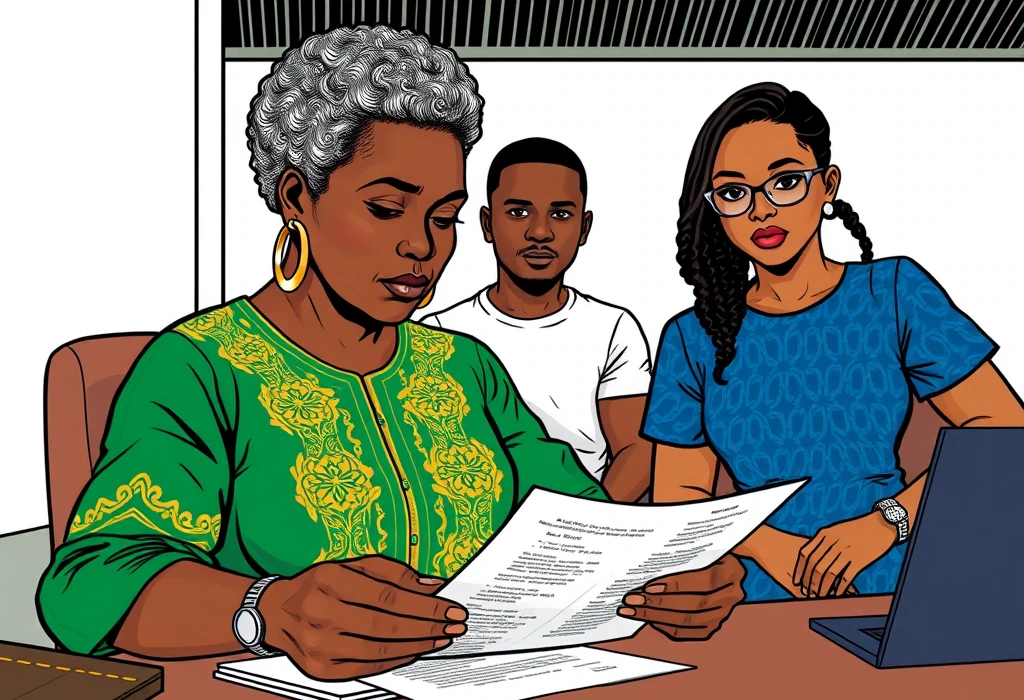
Osas urges his mother to pay while Mrs. Igbinovia examines the suspicious document.
By 8:00 AM, the family was gathered in the living room, the tension thick enough to cut. Osas Igbinovia was pacing back and forth, clutching his phone like a lifeline. "Mummy, we must pay this money," he pleaded, his voice trembling with a mix of excitement and fear. "All my friends already know I am leaving for Canada in September. If we miss this slot, I am finished."
Mrs. Igbinovia held the physical admission letter the agent had printed for them, her thumb running over the slightly smudged college crest. The document looked real, but her thirty years as a high school principal made her deeply suspicious of the agent's sudden rush tactics. "Osas, wait," she said firmly. "Why is a university in Canada asking for Naira to be paid into a personal bank account in Benin City? It does not make sense. We are going to get an independent opinion before we touch our savings."
Enter the Counsellor
Efe Nwosu reviews the suspicious admission letter and explains secure payment protocols.
Mrs. Igbinovia and Osas sat in the quiet, air-conditioned Benin City office of Dhub Education. Efe Nwosu, the Dhub counsellor, listened patiently as Mrs. Igbinovia recounted the midnight messages. Efe did not dismiss their panic; instead, she gently reached for the printed admission letter and the WhatsApp screenshots. "Let us look at this together," Efe said, her calm voice immediately lowering the tension in the room.
"A legitimate Canadian college will never request tuition payments through an agent's personal local bank account. They require direct tuition payments using official, encrypted portals like Flywire." Efe turned to her laptop and opened the official Canadian college portal. "I am going to check their database and verify this letter with our colleagues in the United Kingdom who handle our overseas verifications. If this letter is authentic, the school's finance office will have a record of Osas's student ID."
The Unmasking
Efe uncovers the forged document and confirms the college has no record of Osas.
The room went completely silent as Efe Nwosu pointed to her screen. "The college finance department in Ontario has just confirmed that this student ID does not exist in their system," Efe explained, her silver spectacles catching the light. "Furthermore, the tuition for international students at this institution is fixed between $16,000 and $25,000 per year, and they do not offer random 15% discounts via WhatsApp."
She pulled up a genuine offer letter from the same college to show them the difference. The agent's letter had a forged signature and an outdated logo. Osas stared at the screen, his face turning pale as the reality of the scam sank in. "He almost took everything," Osas whispered, his hand shaking. Mrs. Igbinovia gripped her son's shoulder tightly. "We did not send the money, Osas," she said softly, her voice filled with immense relief. "We caught them in time."
The Safe Path Forward
The Igbinovia family begins their verified application process with Efe's guidance.
Two days later, Mrs. Igbinovia and Osas returned to Dhub Education to officially begin their application process. Efe Nwosu walked them through the secure, legitimate pathway. "Every single transaction we make will go directly to the university's official bank account," Efe promised, handing Mrs. Igbinovia a written breakdown of Dhub's own counseling fees.
"You will pay nothing to any personal accounts, and you will receive automated receipts directly from the school's portal." Osas smiled for the first time in days, looking at the clear checklist of required documents. The family had preserved their dignity, saved their hard-earned money, and were now on a verified path to Canada. As they stood up to leave, Mrs. Igbinovia turned to Efe with a warm smile. "Thank you for asking the questions we did not know to ask," she said, her voice filled with genuine gratitude.
What this story proves: Always verify admission letters directly with the university's finance office and never pay tuition fees into personal or local intermediary bank accounts.
Red Flags in Study-Abroad Agent Agreements
Parents must remain alert to specific red flags when dealing with any education consultant. Avoid any consultant who demands large upfront fees without a clear contract, promises a "guaranteed" visa, or uses rush tactics to force immediate payments. In some notorious cases, fraudsters have offered families a discount on tuition if they pay the agent directly, using stolen credit cards to make temporary payments to the school that are later reversed, leaving the family empty-handed. Always verify the identity of anyone claiming to represent a university. Legitimate consultants will never block you from directly reviewing your admission documents or contacting the university's finance office to verify fee demands.
Immediately contact your bank's fraud department if you suspect transaction fraud.
Once you realise a fraud has occurred, stop all contact with the scammer immediately and save all evidence, such as emails, screenshots, and payment details. Contact your bank's fraud department immediately to flag the transactions and attempt to block further transfers. Additionally, contact the intended university directly to verify if there is any genuine account issue; scammers frequently pretend to be from the school's billing office and claim tuition is overdue, threatening enrollment cancellation to pressure you. Finally, be highly cautious of "recovery" scams that target previous victims by demanding upfront fees to retrieve lost money.
Frequently asked questions
How can I verify if an admission letter from a foreign university is genuine?
You should contact the university's admissions or finance office directly using the phone number or email address listed on their official website. Avoid using contact details provided by the agent. A legitimate institution will be able to verify your student ID and admission status in their database.
What is the safest way to pay tuition fees to an international school?
The most secure method is to make direct payments to the university's official bank account or use vetted, encrypted payment platforms listed on their official website, such as Flywire. Never transfer tuition fees to an agent's personal or local corporate bank account.
How do I report a study abroad scammer to the EFCC?
You can file a report with the Economic and Financial Crimes Commission (EFCC) by visiting efccnigeria.org and using the 'Report a Crime' section. Alternatively, you can email info@efcc.gov.ng, call their toll-free line, or visit any EFCC zonal office in person with your transaction receipts and communication records.
Researched and drafted with AI against the sources listed above, then published by Dhub Education. Policies and costs change quickly — always confirm details with the university or the relevant government body before you act.