How to Report a Study Abroad Scammer in Nigeria: A Parent's Recovery Guide
A practical guide for Nigerian parents on how to report a study abroad scammer in Nigeria, protect tuition payments, and recover lost funds safely.
August 16, 2026
10 min read
Dhub Editorial
Short answer: To report a study abroad scammer in Nigeria, visit efccnigeria.org and use the 'Report a Crime' section, call the EFCC toll-free line, email info@efcc.gov.ng, or visit any EFCC zonal office in person with your transaction receipts, communication records, and any identifying details of the scammer.
The short version
The EFCC is the primary body for reporting tuition fraud, and filing a report or undergoing an investigation is completely free.
If a study-abroad scam involves deception regarding travel for work that leads to exploitation, file a parallel report with NAPTIP.
Beware of recovery scams where fraudsters contact past victims claiming they can retrieve lost funds in exchange for an upfront fee.
Always pay tuition fees directly to the university's official bank account or their verified payment processors like Flywire.
The Threat of Tuition Scams: Why Nigerian Families Are Targeted
Discovering that you have been defrauded by an unverified admission agent is a devastating experience for any Nigerian family. With the volatile exchange rate of the Naira making overseas education more expensive than ever, losing hard-earned money to a scammer is a massive blow. If you find yourself in this situation, knowing how to report a study abroad scammer in Nigeria is critical to protecting your family's assets and seeking child's educational future.
Many fraudulent agents masquerade as official representatives, demanding upfront fees for visa processing, accommodation, or fake admission letters before disappearing entirely. To protect other families and stand a chance of recovering your funds, you must act decisively and use the official reporting channels established by the Nigerian government. Verify your agent's practices early using our parent's practical guide to spot these issues before they start.
How to Report a Study Abroad Scammer in Nigeria
The primary agency responsible for investigating financial crimes and cyber fraud in Nigeria is the Economic and Financial Crimes Commission (EFCC). If you have been defrauded, you can report the scammer directly to the EFCC through several official channels.
To file a report, you should gather all available evidence, including chat histories, emails, transaction receipts, bank account numbers, and any identity documents the scammer provided. You can submit this information via the 'Report a Crime' portal on the EFCC website (efccnigeria.org), send an email to info@efcc.gov.ng, or call the EFCC toll-free line. For a stronger impact, you can also visit any EFCC zonal office in person with your evidence files.
It is important to note that reporting and investigations by the EFCC are completely free. If anyone demands a fee to process your complaint or speed up an investigation, they are committing further fraud against you. Additionally, if the scam involved being deceived into travel for work that turned into exploitation, you must file a parallel report to the National Agency for the Prohibition of Trafficking in Persons (NAPTIP) at naptip.gov.ng.
Comparison of Official Tuition Payments vs. Unverified Intermediaries
Payment Aspect
Official Direct Payment
Unverified Third-Party Agent
Payment Destination
Direct to university's official bank account or verified portal (e.g., Flywire)
Private or local agent accounts not listed on the school's website
Security Measures
Utilises HTTPS secure websites and two-factor authentication (2FA)
Lacks encryption; often requests sensitive details via email or social media
Receipt Verification
Official payment receipt sent directly from the university's finance portal
Manual, easily forged receipts with unverified stamps
Compliance Checks
Adheres to anti-money laundering (AML) laws and OFAC sanctions screening
No regulatory oversight; prone to card fraud or hidden fees
Gathering all receipts and chats is the first step when filing an EFCC report.
The Recovery Trap: Spotting Secondary Scams
After losing money, many parents become highly vulnerable to what security experts call 'reloading scams.' In these schemes, fraudsters buy lists of previous victims from other scammers and contact them under a new guise. They may pretend to be recovery agents, security officials, or representatives of a government compensation fund set up to refund victims of fraud.
These recovery scammers will claim they can track down your lost tuition money or apprehend the fraudulent agent, but they will demand an upfront 'processing fee,' 'tax,' or 'clearance charge' before releasing the funds. A legitimate authority will never ask for personal money to recover stolen funds. If you suspect you are being targeted, immediately cut off communication and report the interaction.
A family Sunday dinner turns into a search for answers when a mother discovers her son's tuition deposit was never received by his UK university.
Mrs. Nike Adeyemi — Mother, high school principal in Lagos
Tobi Adeyemi — Son, aspiring international student
Uncle Dele — Nike's brother, self-appointed travel expert
Kemi Vance — Dhub Education counsellor
The Silent Alarm
Nike worries over an unverified tuition receipt while Dele continues eating his lunch.
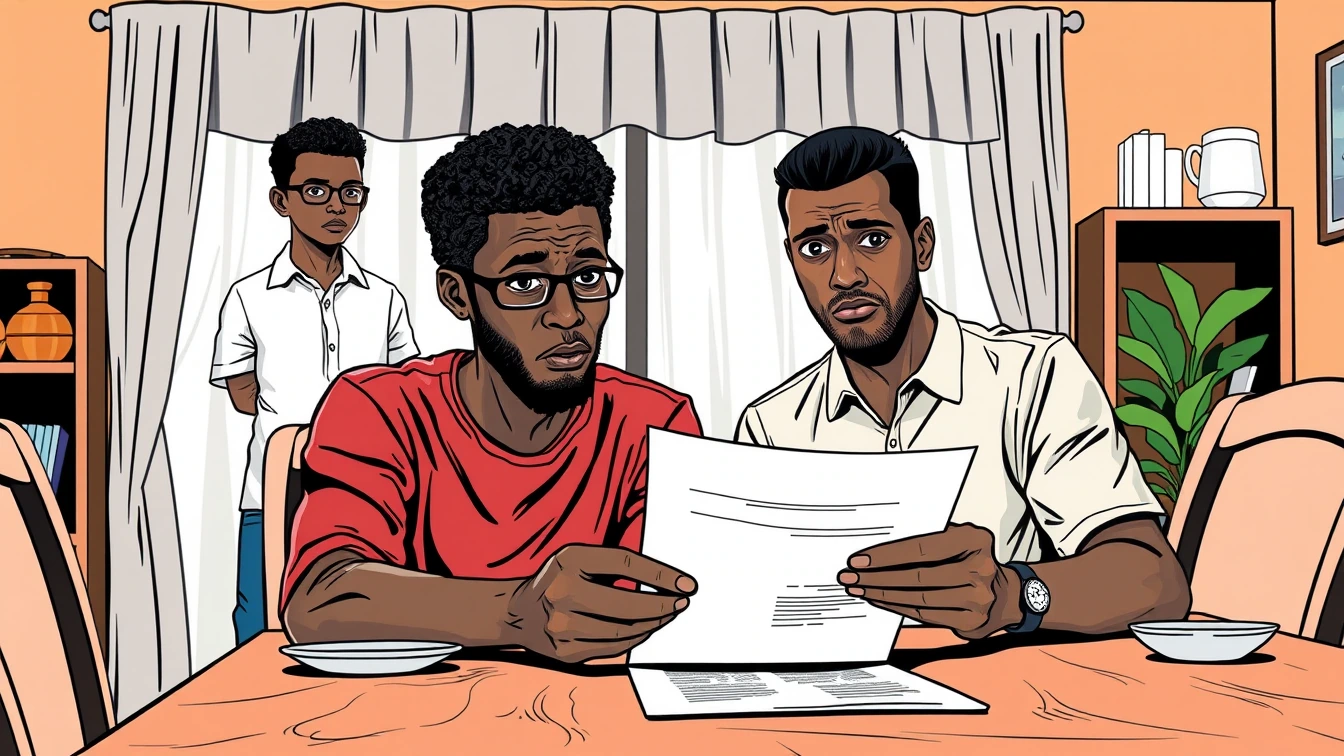
The scent of jollof rice and fried plantain filled the dining room, but Mrs. Nike Adeyemi could not bring herself to take a bite. Instead, she stared at her phone, her thumb hovering over an email from Leeds Trent University. Tobi sat across from her, nervously shredding a paper napkin, while Uncle Dele was already on his second helping of beef. The email from the university finance department was brief: they had no record of the £4,000 deposit supposedly paid by Tobi's agent.
"Nike, eat your food before it gets cold," Uncle Dele boomed, his voice rattling the water glasses. "I told you, Chief Alabi's agency is solid. He has offices in Ikeja! He even gave us a receipt with a shiny gold stamp." Nike sighed, showing the screen to her brother. "Dele, the stamp is shiny, but the university says they have received zero Naira and zero Pounds. The deadline was yesterday."
The Curdling of Agent Promises
The agent's sudden demand for more fees leaves the family in deep shock.
Tobi’s face went pale. He had already told his former classmates that he was moving to the UK next month. "But Chief Alabi said the transfer takes time because of Central Bank regulations," Tobi whispered, his voice trembling under the weight of his dashed hopes. Uncle Dele waved his fork dismissively. "These foreign banks are slow. Let me call Alabi right now and settle this."
Dele dialed the number, putting the phone on speaker in the middle of the dining table. The line clicked, and the smooth, buttery voice of the agent answered. However, when Nike demanded the swift transfer document or the bank's transaction reference number, the agent's tone instantly shifted. "Madam, if you keep doubting my integrity, I will cancel the application myself," the agent snapped. "There is a new international student tariff of five hundred thousand Naira from the ministry. Pay that today, or your son's visa file is closed." The line went dead.
Enter the Voice of Reason
Kemi Vance from Dhub Education points out the irregularities on the agent's receipt.
A knock at the front door broke the heavy silence. Nike had invited Kemi Vance, a counsellor from Dhub Education, to review Tobi's documents after feeling uneasy the previous evening. Kemi walked in, carrying a neat leather folder, her expression calm and professional. She took a seat at the table, declining the offer of food with a polite smile, and immediately looked at the printed receipt Chief Alabi had provided.
"Let me look at this receipt," Kemi said softly. She compared the details on the document with the official Leeds Trent portal on her tablet. "This receipt uses a bank account in Lagos that belongs to a private individual, not the university. Legitimate schools require direct payments to their own accounts or verified platforms." Uncle Dele frowned, his confidence wavering. "But he said he was an official representative! He had a banner with the school logo!" Kemi shook her head. "Anyone can print a banner, Uncle Dele. We must verify every link."
Exposing the Paperwork
Kemi explains how secure university portals protect families from unauthorized third-party transactions.
Kemi opened her folder to show Nike how a real admission process is documented. "At Dhub Education, we never accept tuition payments into our own accounts," Kemi explained, showing a sample of a formal university instruction sheet. "We guide you to pay the university directly using their approved payment channels, so you get an immediate receipt from the school." She pointed to the portal details on her screen.
"I have our colleague in London checking with the Leeds Trent admissions office directly. They have confirmed that Chief Alabi is not on their list of approved representatives, and the admission letter he gave you is a modified template." Nike felt her stomach drop, but she also felt a strange sense of clarity. The deception was out in the open. "He took four million Naira," Nike said, her voice tight. "How do we get it back? Is Tobi's dream over?"
The Plan of Action
The family drafts an EFCC report with Kemi's guidance to recover their funds.
Kemi laid out a clear sheet of paper. "First, we must file a report with the EFCC," Kemi said. "Reporting is completely free, and we have all the WhatsApp chats, receipts, and bank details of this agent." She helped Nike draft the initial complaint email to info@efcc.gov.ng, ensuring every transaction reference was attached. "Second, we will restart Tobi's application properly. Leeds Trent still has open slots, and we can submit his genuine WAEC results directly through our verified system."
Uncle Dele, now completely sobered, patted Tobi on the back. "I will drive you to the EFCC office myself tomorrow, Nike. This Alabi will not run away with our family sweat." Tobi looked at Kemi, a faint smile finally returning to his face. "So I can still go?" he asked. Kemi smiled back. "We will do it the right way, Tobi. Directly, safely, and with every receipt coming straight from the university."
What this story proves: Never pay tuition fees through an agent's private account; verify every admission letter directly through official university channels.
Direct Payments: Safe Ways to Send Tuition Fees Abroad
The most effective way to avoid tuition payment scams is to bypass third-party intermediaries entirely. You should always make direct transfers to the university's official bank account or use the specific payment processor listed on the school's own website, such as Flywire or other encrypted platforms.
Before initiating any international money transfer, contact the university directly through a verified phone number or email address to confirm their exact beneficiary name, SWIFT/IBAN details, and your unique student reference number. Never rely on payment links sent via email from unknown senders, and avoid individuals on social media offering 'discounted' tuition payment rates. Real payment operators always set clear terms and timelines instead of pressuring you to act fast.
Additionally, make sure you use secure internet connections (HTTPS) and enable two-factor authentication (2FA) on all financial accounts to keep your transactions safe from cybercriminals.
Direct payment to the university via secure portals prevents intermediary fraud.
If your family has been affected by an unverified agent, you do not have to abandon your child's study-abroad dreams. Many universities are aware of student fraud and are willing to work with families who show genuine intent and clear proof of their situation. However, you must change your approach to documentation and payment security.
To avoid future pitfalls, families should partner only with professional, verifiable consultancies that have an established physical presence and a track record of direct university communications. For a detailed breakdown of how to identify safe partnerships, read our guide on unfakable trust signals for skeptical parents.
Always remember to document every step, refuse to pay through unauthorised local agents, and ensure that every pound or dollar sent is tracked directly through official university channels.
Frequently asked questions
How do I report a study abroad scammer to the EFCC in Nigeria?
You can report a scammer by visiting efccnigeria.org and using the 'Report a Crime' section, calling the EFCC toll-free line, emailing info@efcc.gov.ng, or visiting any EFCC zonal office in person with your communication records and transaction receipts.
Does the EFCC charge a fee to investigate tuition fraud?
No, reporting to and being investigated by the EFCC is completely free. Anyone claiming you must pay a fee to process your report or speed up an investigation is committing further fraud. You should never pay anyone to follow up an EFCC case.
What should I do if the scammer also deceived my child into traveling abroad for work?
If your case involves elements of being deceived into travel for work that turned into exploitation, you should report simultaneously to the National Agency for the Prohibition of Trafficking in Persons (NAPTIP) at naptip.gov.ng. NAPTIP works closely with the EFCC on overlapping cases.
How can I avoid tuition payment scams when transferring money abroad?
Always pay tuition directly to the university's official bank account or payment portal. Avoid using unauthorised third-party agents, social media contacts, or unverified links received by email. Always confirm the school's bank details directly through their official website.
Researched and drafted with AI against the sources listed above, then published by Dhub Education. Policies and costs change quickly — always confirm details with the university or the relevant government body before you act.