Short answer: To choose a course for a UK student visa from Nigeria, you must select a programme that demonstrates clear academic progression from your previous studies. The Home Office requires the new course to be at a higher level or related to your career goals, supported by specific module knowledge and a documented post-study plan.
The short version
- UKVI caseworkers flag 'inconsistency' between your application and interview as a primary reason for visa refusal.
- The academic progression requirement (ST5.1) means your new course must be at a higher level or logically linked to your past studies.
- You must memorise at least three core modules and explain how they provide skills unavailable in Nigeria.
- A vague career plan like 'I want a better job' is insufficient; you need specific target roles and salary expectations.
- Embedded placement years are more valuable for employability than short, competitive internships.
The Risk of the 'Generic' Course Choice
For many Nigerian families, the journey to the UK begins with a search for any available Master’s degree. However, learning how to choose a course for UK student visa from Nigeria requires more than just picking a title that sounds prestigious. If your chosen course does not align logically with your academic background or work experience, it raises immediate red flags with the Home Office. Under Appendix Student (ST 5.1), you must prove you are a 'genuine student'.
A common mistake is selecting a 'General Management' degree when your background is in a technical field like Nursing or Engineering without a documented professional reason for the switch. Caseworkers look for a transparent narrative. If you cannot explain why this specific syllabus is the natural next step, your application may be refused before you even pack a bag. At Dhub Education, we see families every day who have been advised by unverified agents to take the 'easiest' course, only to face a 10-year ban for what the UKVI perceives as deception or lack of credibility.
Understanding the Academic Progression Requirement
The Home Office is strict about 'academic progression'. This usually means your new course must be at a higher level than your previous one—for example, moving from a Bachelor’s to a Master’s. If you are applying for a second Master’s or a course at the same level, the rules are even tighter. In these cases, the university must justify why you are not moving 'up', and you will likely face a credibility interview to explain the logic.
According to the University of Cambridge, academic progression can be met at the same level if the new course is related to the previous one or, combined with it, supports your specific career aspirations. For a Nigerian student, this means your personal statement must be a bridge, not a list. You must show how your previous 2:1 in Accounting leads naturally to a Master's in Forensic Accounting, rather than just 'more accounting'.
Course Choice Risk Assessment for UK Student Visas| Scenario | Risk Level | UKVI Perception |
|---|
| BSc to MSc in the same field | Low | Natural academic progression. |
|---|
| Career change with 3+ years work exp | Medium | Acceptable if work history is documented. |
|---|
| MSc to a second MSc at the same level | High | Requires strong justification from the sponsor. |
|---|
| Random stream switch (e.g. Art to IT) | Very High | Likely refusal without deep professional proof. |
|---|
The Three-Module Test for Credibility
One of the most frequent points of failure in the UK student visa credibility interview is a lack of specific course knowledge. Caseworkers expect you to have 'dissected your university’s academic prospectus'. You should be able to name at least three core modules and provide a one-sentence summary of what you will learn in each. If you say, 'I am studying Business because it is good,' you are inviting a refusal.
Instead, focus on modules that offer something unavailable in Nigeria. For instance, if you are studying Renewable Energy, you might highlight a module on 'Offshore Wind Farm Grid Integration'. This level of detail proves you have researched the programme and are not simply using the student visa as a back-door entry for work. Remember, working while studying in the UK is a right, but it must never appear to be your primary motivation during the interview.
The Story
The Silent Witness in the Parlour
A bright student's UK dream almost derails until a younger sibling's blunt question about 'meaningless' modules forces a pivot to a logic-backed strategy.
- Chidera — Aspiring student with a background in Microbiology
- Mrs. Ifeoma — Chidera's mother, a no-nonsense secondary school vice-principal
- Obinna — Chidera's 16-year-old brother, observant and tech-savvy
- Mr. Kelvin — Dhub Education Counsellor
The Celebration Begun Too Early
The parlour was filled with the smell of jollof rice and the rhythmic thumping of the generator outside. Chidera was glowing, showing her mother a glossy print-out of a university brochure. 'Mummy, it’s settled,' she chirped, pointing at a header that read 'Master of Business Management'. 'The agent in Ikeja said this is the fastest way to get a visa. No stress, no hard science anymore.'
Mrs. Ifeoma adjusted her glasses, peering at the document. She had already started a mental tally of the millions needed for the deposit. 'Business? But your certificate from Unilag says Microbiology, Chidera. Is this what you want to do, or just what is easy?' she asked, her vice-principal voice cutting through the excitement. Chidera waved a hand dismissively. 'Mummy, everyone does Business. It’s for people who want to lead. The agent said it’s a sure thing.'
The Small Voice of Logic
Obinna, who had been slumped in an armchair with his headphones around his neck, finally looked up. He had been reading over Chidera’s shoulder for ten minutes. 'Sis, what’s “Strategic Human Capital”?' he asked, his voice cracking slightly with puberty. Chidera blinked. 'It’s... you know, managing people. Like a boss.'
Obinna didn't smile. 'Okay, but what’s the difference between that and the “Organisational Behaviour” module on the next page? And why are you doing this instead of that Vaccine Research thing you used to talk about?' Chidera opened her mouth to answer, then closed it. She flipped through the brochure, her fingers hovering over the text. The silence in the room stretched, punctuated only by the hum of the fridge. 'The agent just said it’s a good course,' she whispered. Obinna shook his head. 'If you can’t explain it to me, how will you explain it to the white man at the visa office?'
The Night of Doubt
By ten o'clock, the celebratory mood had evaporated like mist. Mrs. Ifeoma sat at the dining table, her ledger open, but her pen wasn't moving. 'Chidera, come here,' she called. Chidera walked in, her braids swinging. 'I’ve been reading about this “credibility interview” on the Dhub Education blog. It says if your course doesn’t match your past, they will think you are lying.'
'But Mummy, the agent said—' Chidera started, but her mother cut her off. 'The agent is not the one who will be banned for ten years if they catch a lie. You spent four years studying bacteria and viruses. Why would the UK believe you suddenly want to be a bank manager? We are not throwing five million Naira into a hole because of a “sure thing” that doesn’t make sense.'
The Professional Verdict
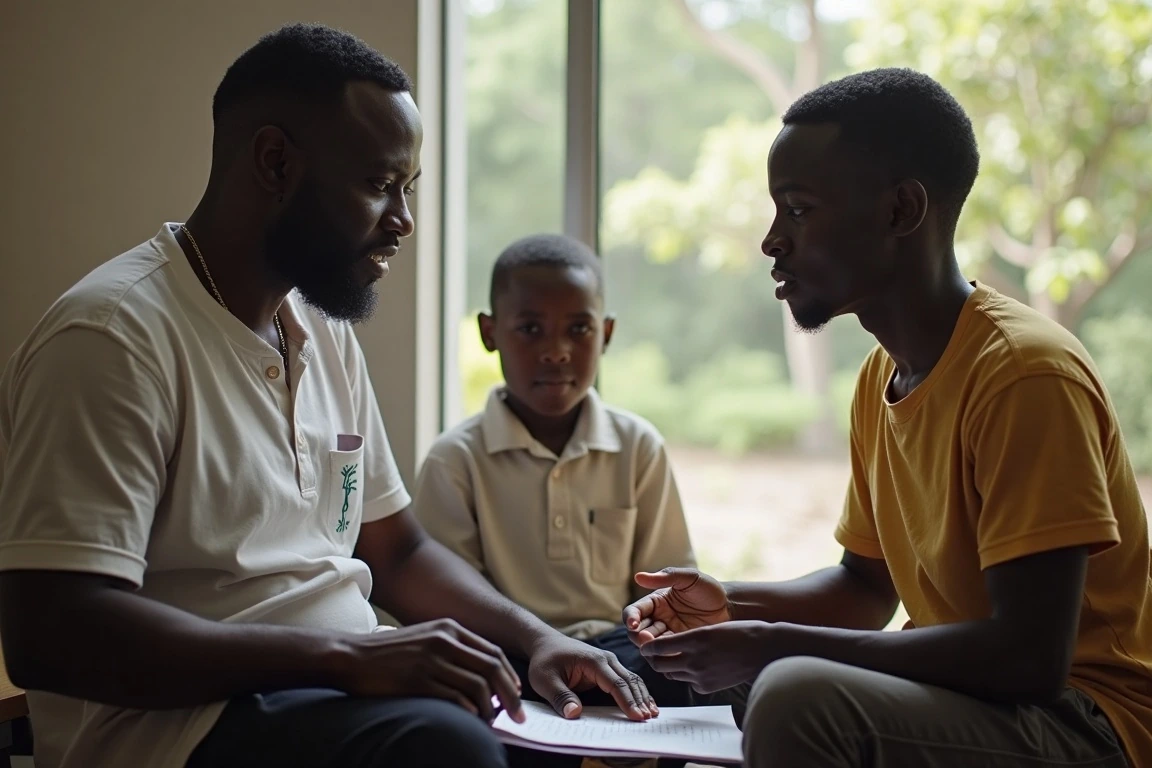
The next morning, they were in the Dhub Education office. Mr. Kelvin didn't look like the agent in Ikeja; there were no '100% Visa' posters on his walls, just maps and a library of university prospectuses. He listened to Chidera’s plan, then gently pushed the Business brochure aside. 'Chidera, this is what we call a high-risk alignment,' he said calmly. 'You have a strong degree in Microbiology. Applying for general Management without a work history in it is a recipe for an ST5.1 refusal.'
He pulled out a different prospectus. 'Look at this: MSc in Biotechnology with Industrial Management. It covers the science you know, but adds the leadership skills you want. It’s a logical progression. When the caseworker asks why this course, you can tell them exactly how it helps you run a lab back here in Lagos.' Chidera felt a weight lift from her chest. For the first time in weeks, the path ahead didn't feel like a trick.
The Mock Interview
Two weeks later, the parlour was a different place. No jollof rice this time—just Chidera, a notebook, and Mr. Kelvin on a video call. 'Question four, Chidera,' Kelvin’s voice came through the laptop. 'Why this university and not one in Nigeria?' Chidera didn't hesitate. 'Because the University of Hertfordshire offers a specific module in Bioprocessing Technology that isn't available at the postgraduate level in my local institution, and they have links to GlaxoSmithKline for placements.'
Mrs. Ifeoma watched from the doorway, her arms crossed. She wasn't smiling yet, but the tension in her shoulders had vanished. Obinna walked past, giving his sister a thumbs-up. Chidera wasn't reciting a script; she was explaining a career. She knew her modules, she knew her costs, and she knew exactly which office in Ikeja she would be applying to for a job when she returned. The logic was finally hers.
The Logic That Wins
The visa arrived on a Tuesday, exactly like the day the generator had hummed over their confusion. There was no shouting this time, just a quiet, deep relief. Chidera held the passport, her eyes tracing the vignette. 'Mummy, I’m going,' she said softly. Mrs. Ifeoma took the passport, checking the dates with a vice-principal’s precision before handing it back. 'You are going because you told the truth, and the truth made sense,' she said.
Obinna looked up from his phone. 'Does this mean I get your room?' he joked, but his eyes were bright with pride. Chidera laughed, hugging her brother. She realized now that the 'easy' way the first agent offered was actually the hardest path possible. By choosing a course that respected her past and planned for her future, she hadn't just won a visa—she had won a career. They weren't just 'japa-ing'; they were progressing.
What this story proves: A visa is won by the logic of your course choice, not the speed of your agent.
Building Your Career Narrative Backwards
To win a visa, you must choose your course by looking at the Nigerian job market first. A 'genuine student' has a 30-second post-study plan that includes specific companies in Nigeria, specific roles, and realistic salary expectations in Naira. Caseworkers flag generic answers like 'I will get a better job' as a sign that the applicant does not intend to return home, which is a key requirement for the Student route.
When we work with families at Dhub Education, we help them map out this career path. We look at the gaps in the Nigerian economy—such as data analytics in fintech or specialist clinical skills—and find courses that fill those gaps. This makes the 'intent to return' argument much stronger. If you can show that a UK degree will increase your earning potential in Lagos or Abuja by 40%, the caseworker sees a logical investment, not a flight risk.
Placement Years: The Employability Edge
If your goal is graduate employability, you should look for programmes with embedded, year-long placements. Research suggests that employers value at least six months of work experience, and a placement year is often paid and costs less in tuition than a standard academic year. However, you must verify that the university can sponsor the necessary work permission, as most can only sponsor a limited number of visas for these activities.
A placement year provides a 'global mindset' that is highly attractive to Nigerian multinationals. However, be careful: a short, competitive internship is not the same as a guaranteed placement. Always ask the university for recent evidence of where their international graduates actually work, rather than relying on a wall of corporate logos on their website.
Why Professional Guidance Matters
Choosing the wrong course is a mistake that costs millions of Naira and years of planning. Many Nigerian families try to navigate the complex 'genuine student' rules alone, only to be tripped up by a single inconsistent answer in an interview. This is where Dhub Education steps in. We don't just 'apply'; we audit your academic history, stress-test your course choice against UKVI guidance, and ensure your narrative is bulletproof.
If you have already received a refusal based on credibility, the path forward is difficult but not impossible. You will likely need to apply to a different university with a materially changed set of circumstances. Don't leave your future to chance or unverified advice. Let a professional team with a presence in both Nigeria and the UK guide your selection.
Frequently asked questions
What is the most common reason for a UK student visa refusal in Nigeria?
The leading cause is inconsistency between the written application and the verbal interview. If your answers about your course, finances, or career plans contradict your documents, it can trigger a refusal under paragraph 9.7 for deception or lack of credibility.
Can I study a different subject from my Bachelor's degree?
Yes, but you must demonstrate academic progression. If the subjects are unrelated, you need a strong, documented career justification—such as work experience in the new field—to satisfy the 'genuine student' requirement (ST5.1).
How many modules do I need to know for my interview?
It is highly recommended to memorise at least three core modules by name and provide a one-sentence summary of each. A failure to describe what you will actually be studying is a frequent reason for credibility refusals.
Is a placement year better than a standard degree?
For employability, yes. A year-long, embedded placement is highly valued by employers and often provides a 'global mindset'. However, you must ensure the university can sponsor the visa for the placement period.
Related reading
Have questions about your own situation?
Every family's paperwork, budget and timeline is different. If you would like a second opinion or help getting started, reach Dhub Education directly:
Talk it through with Dhub Education
Your course choice isn't just about what you'll learn; it's about whether you'll even get the chance to arrive. If you're unsure if your background matches your UK dream, talk to a Dhub Education counsellor today for a professional course audit.
Book a free consultation
Sources
Researched and drafted with AI against the sources listed above, then published by Dhub Education. Policies and costs change quickly — always confirm details with the university or the relevant government body before you act.