How to Verify a Study Abroad Agent in Nigeria: The New Transparency Standard
A practical guide for Nigerian parents on how to verify a study abroad agent in Nigeria, covering the UK Agent Quality Framework and official university partner lists.
August 12, 2026
12 min read
Dhub Editorial
Short answer: To verify a study abroad agent in Nigeria, cross-reference the agency's name against the official 'Agent Partners' directory on your target university's website, demand proof of British Council certified training, and ensure full compliance with the UK Agent Quality Framework (AQF) ethical pillars.
The short version
Always cross-reference your agent's name on the official partner directory of your target university's website before signing any contracts.
Under the UK Agent Quality Framework (AQF), official agents must clearly communicate their fees, services, and institutional relationships.
According to industry bodies, many university-partner agents receive institutional funding, but you should ask any agent — including this one — for its fee structure in writing before paying.
Sponsors must manage recruitment agents in line with the UK Agent Quality Framework to protect students and maintain visa compliance.
Submitting unverified or forged documents prepared by unregulated agents can lead to an automatic ten-year UK visa ban.
Why You Must Demystify the Admissions Process
For many Nigerian parents, funding an international degree represents the culmination of years of hard work, sacrifice, and hope. Yet, the path to securing admission and a student visa is often shadowed by unregulated actors. Unregulated agents frequently exploit families by providing misleading information, charging exorbitant processing fees, and, in the worst cases, presenting forged documentation that leads to devastating consequences.
To protect your family's hard-earned savings and secure your child's future, you must learn how to verify a study abroad agent in Nigeria. Engaging with unethical agents has historically caused African students financial loss, avoidable visa refusals, academic disruption, and severe emotional distress. By demanding transparency as a non-negotiable standard, you can bypass these traps and ensure a secure path for your child.
For a detailed look at the physical and digital red flags to watch out for, read our guide on the unfakable trust signals for skeptical parents. True transparency is not a luxury; it is a standard that every family must demand from day one.
The Direct University Partnership Verification Test
The most reliable and straightforward way to determine if an educational consultant is legitimate is to check their direct institutional partnerships. Global universities maintain and publish official lists of their vetted, commissioned representatives. If an agency claims to represent a specific university but does not appear in that university's public directory, they are likely operating as an unvetted sub-agent. This significantly increases the risk of administrative errors, hidden fees, and application delays.
You can verify these partnerships directly on the target university's website. For example, if an agent claims to represent the University of Regina in Canada, you can cross-reference their name with the official directory to find verified partner agents such as Cappucino Consulting Clinic, MOAF Consulting, Mo Consult and Travels, and YESSDA Contractors Ltd, among others. Similarly, the University of East London publicly lists its trusted Nigerian partners on its website, including Jokings Educare Lagos, Midstrom Ridge, and StudyIn Lagos, alongside other trusted partners like Study Affairs (Ikeja), Study Now (Victoria Island), and TGM Education (Ikeja).
Additionally, the University of Plymouth lists official Nigerian agents such as AHZ Associates, AMS BridgeBlue Nigeria, Jestone Education, and IDP Nigeria. If your chosen agent's name is absent from these official directories, you should proceed with extreme caution.
Comparison Between Official University-Partner Agents and Unregulated Travel Agents
Feature
Official University-Partner Agent
Unregulated Travel Agent
Primary Funding Source
Direct institutional commissions paid by universities
Upfront consulting or 'processing' fees charged to families
UKVI & AQF Compliance
Strictly aligned with Agent Quality Framework and audited by sponsors
Unregulated, with no institutional oversight or code of conduct
Admissions & Support Fees
Foundational admissions and counselling placements are 100% free
Heavy upfront fees for admissions or visa applications
Document Standards
Rigorous verification of genuine bank statements and academic records
High risk of fraudulent or 'assisted' paperwork leading to visa bans
University Directory Listing
Publicly listed on official university 'Agent Partners' web pages
Absent from official directories; often operating as unvetted sub-agents
Information sessions and workshops help Nigerian families demystify the study-abroad process.
Demanding Compliance with the UK Agent Quality Framework (AQF)
To standardise ethical practices globally, the United Kingdom has introduced robust frameworks to govern international student recruitment. The UK Agent Quality Framework (AQF) is a sector-wide initiative jointly led by the British Council, BUILA, UKCISA, and Universities UK International (UUKi) to enhance governance, transparency, and professional competence in recruitment.
The AQF is built upon a National Code of Ethical Practice that sets out five core pillars: Organisational Behaviour, Ethical Business Practice, Objective Advice, Student-Centred Practice, and Professionalism. Under the new UKVI student sponsor guidance that took effect on 8th April 2026, all licensed UK student sponsors using recruitment agents must retain evidence demonstrating how they manage those agents in line with the AQF. This strict framework is designed to improve the quality of recruitment and reduce visa refusal and student drop-out ratios.
When interviewing a potential consultant, ask them directly how they comply with the AQF. To make this screening process simple for your family, we have created a practical afternoon checklist to verify an agent. Legitimate agents will easily demonstrate their alignment with these UKVI-backed standards.
The Story
The Payment Link Panic
When a suspicious payment link makes a protective mother suspect fraud, she discovers that the real danger lay in the forged document package she almost submitted.
Mrs. Funmilayo Adebayo — mother, a secondary school principal from Ibadan
Tobiloba Adebayo — her son, 18, preparing for UK university studies
Amina Yusuf — Dhub Education counsellor
Mr. Charles — an independent travel agent operating from a rented office in Lagos
The Panic over the Portal
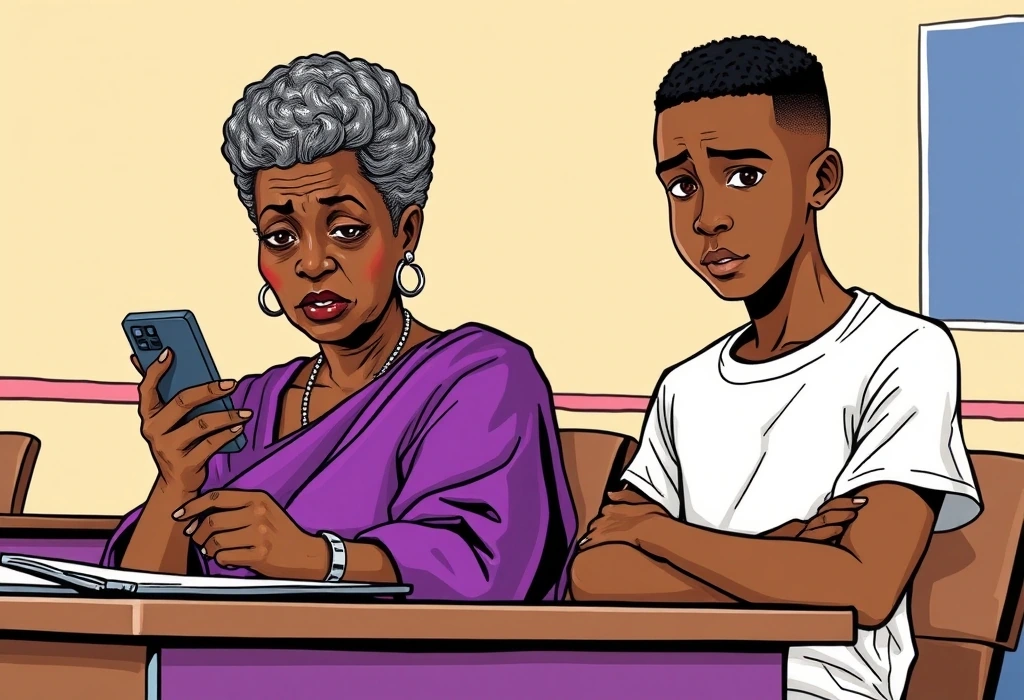
Mrs. Funmilayo Adebayo and her son Tobiloba panic over a strange payment notification.
Mrs. Funmilayo Adebayo stared at her phone as the noisy generator outside her school office hummed. A message from Dhub Education had just arrived, containing a link to a payment portal she had never heard of. It asked for a tuition deposit of £2,000. She felt a cold dread. Her son, Tobiloba, was already packing his bags, telling all his friends that he was leaving for the United Kingdom.
"Tobiloba, come and see this!" Funmilayo called out, her voice trembling. "They said we should pay into this strange account. I knew it! This Dhub people are trying to run away with our money."
Tobiloba hurried in, looking at the screen with wide, worried eyes. "Mummy, but Amina said this is how we pay. Let us go to their office and demand our documents. I cannot miss this intake."
Funmilayo clutched her handbag tightly. "We are going there right now. No one plays with my hard-earned principal's salary."
Storming the Office
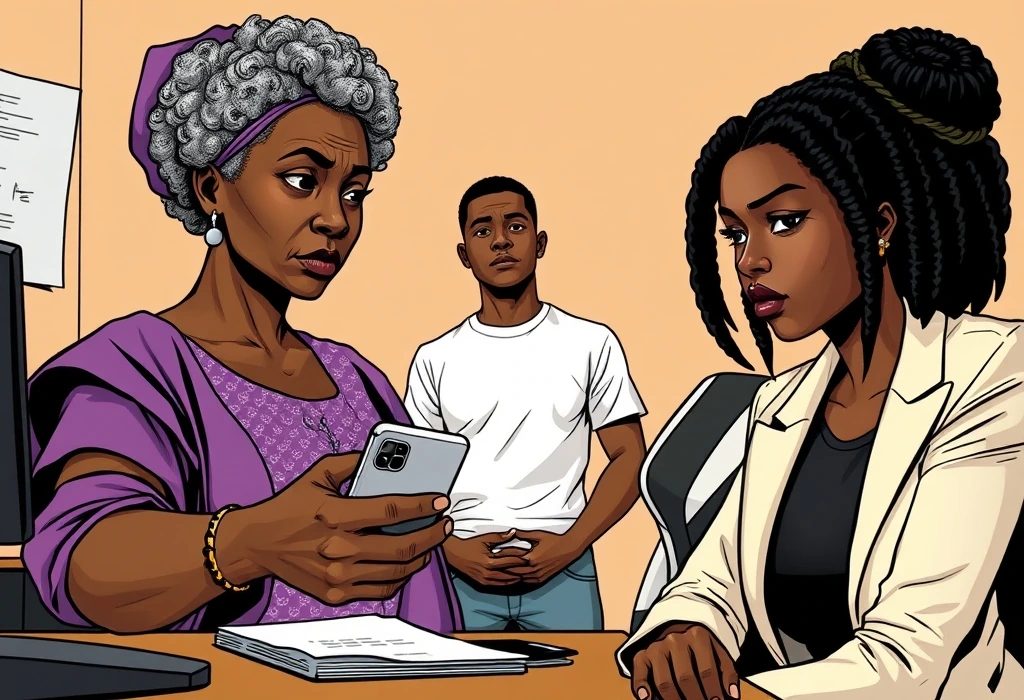
Mrs. Funmilayo demands answers from Amina Yusuf at the Dhub Education office.
The reception at the Dhub Education office was quiet, a sharp contrast to the chaotic Lagos traffic outside. Mrs. Funmilayo marched in, her purple buba rustling, with Tobiloba trailing behind. She bypassed the front desk and walked straight to the desk of Amina Yusuf, the counsellor who had been handling Tobiloba’s UK university application.
"Amina, explain this to me!" Funmilayo demanded, thrusting her phone forward. "Why is this link asking us to pay a third-party platform? We want to pay the university directly. If this is a scam, tell me now before I call the police."
Amina looked up calmly, offering a reassuring smile. "Please sit down, Mrs. Adebayo. I completely understand your fear. Let us look at this together."
Tobiloba sat on the edge of his chair, cracking his knuckles. "Amina, please, my friends already know I am going. Is my admission safe?"
Verifying the Source
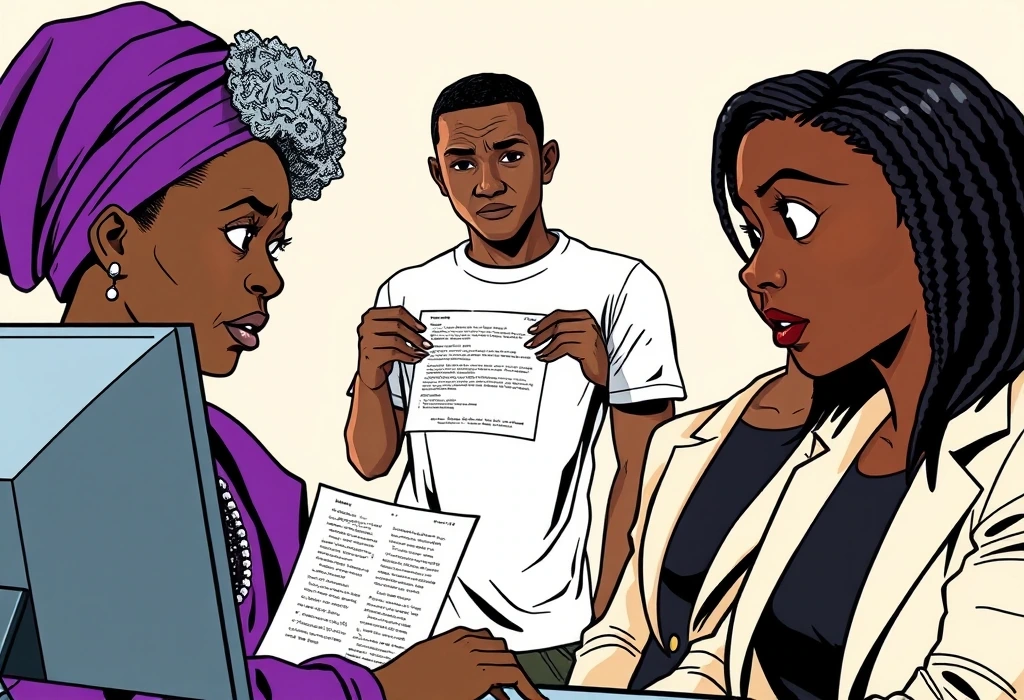
Amina demonstrates how to verify the secure payment link on the university's website.
Amina turned her computer screen to face the anxious mother. "Mrs. Adebayo, what you are seeing is the official Flywire payment link. UK universities use these platforms to process international payments safely. Let me show you how to verify this yourself."
Amina opened a web browser and navigated to the official .ac.uk website of Tobiloba’s target university. She clicked on the 'International Payments' section. There, listed clearly on the university's own verified page, was the exact same payment platform link.
"You see?" Amina explained, pointing to the screen. "You are not paying Dhub. You are paying the university through their official designated portal. The money goes directly to them, not to us."
Funmilayo squinted at the screen, comparing the URLs. Slowly, the tension in her shoulders began to ease. "So... this is actually how they do it?"
"Yes, Mummy," Tobiloba whispered, a wave of relief washing over his face. "It matches exactly."
The True Threat Uncovered
Amina reveals the forged bank statement prepared by their previous independent agent.
Amina’s expression turned serious. "I am glad we verified this, because the real danger was actually what happened before you came to us. Do you remember the independent agent, Mr. Charles, whom you consulted last month?"
Funmilayo nodded. "Yes, Charles. He charged us 450,000 Naira for 'document processing' and said he would handle our bank statements."
Amina pulled up a saved PDF on her screen. "When we took over Tobiloba’s file, we checked the draft documents Mr. Charles had prepared. Look at this bank statement he was planning to submit to the UK Visas and Immigration."
Amina zoomed in on the document. "This statement is a complete forgery. If you had submitted this, the UK government would have issued Tobiloba an automatic ten-year ban for deception. You would have lost your money and his future."
Tobiloba gasped, his face turning pale. "Ten years? I would have been banned?"
Confronting the Past
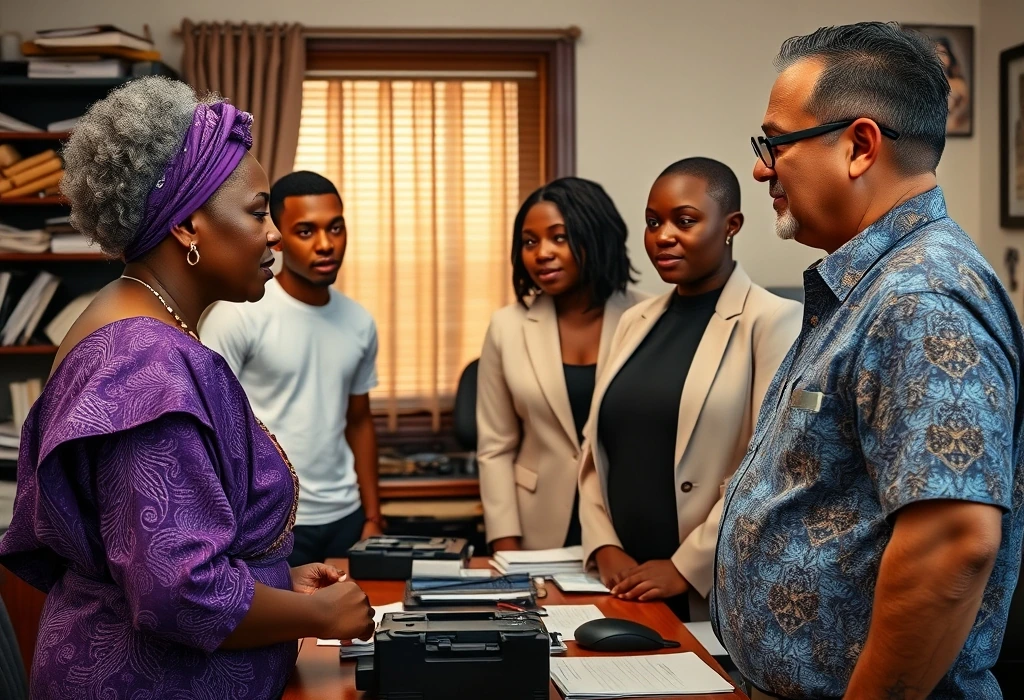
Mrs. Funmilayo confronts Mr. Charles about the fraudulent bank statement.
Later that afternoon, determined to get her processing fee back, Mrs. Funmilayo insisted on visiting Mr. Charles’s small, rented office in Ikeja, with Tobiloba and Amina accompanying her for support. Mr. Charles sat behind a cluttered desk, his wire-rimmed glasses sliding down his nose, surrounded by generic study-abroad posters.
"Ah, Mrs. Adebayo! Have you come to complete your payment?" Mr. Charles asked, a slick smile on his face.
"No, Charles," Funmilayo said, her voice steady and commanding. "We have come to collect our 450,000 Naira. We know about the fake bank statement you tried to put in my son's file."
Mr. Charles’s smile vanished. "That is standard practice for students who do not have the full funds ready! We do it all the time."
"It is fraud," Amina said firmly, stepping forward. "And it carries a ten-year UK visa ban. We have already rebuilt Tobiloba’s application with genuine documents and direct university verification."
A Clear Path Forward
Tobiloba's genuine application is secured and the tuition deposit is successfully made.
Back at the Dhub office, the atmosphere was light. Tobiloba’s genuine proof of funds had been verified, and his official payment had gone through the university's secure portal safely. Mrs. Funmilayo sat relaxed, her handbag resting on her lap, a warm smile on her face.
"I am so sorry I doubted you, Amina," Funmilayo said, laughing softly. "In Lagos, if something is too straightforward, we assume it is a trap. I did not know the real trap was the man who charged me half a million Naira to ruin my son's life."
Amina smiled, handing them the printed confirmation of Tobiloba's successful tuition deposit. "You do not need to apologise. It is your job to protect your son. Our job is simply to make sure the truth is always visible."
Tobiloba grinned, looking at the receipt. "Next stop, London!"
What this story proves: Legitimate study-abroad processes are built on visible, verifiable channels, whereas the real danger lies in unvetted shortcuts that carry devastating legal consequences.
The Truth About Agent Fees and Commissions
One of the most common concerns among Nigerian families is navigating the upfront costs of securing admission. While some official university-partner agents act as local representatives of educational institutions, fee structures vary. According to industry bodies, many agents receive referral commissions from universities, but you should always ask any agent—including us—to provide their full fee structure in writing before making any payments.
The UK Agent Quality Framework mandates absolute transparency regarding financial arrangements. Under the AQF code of conduct, agents must clearly communicate information about their services, fees, and institutional relationships while maintaining accurate records of all transactions. If an agent demands large, non-refundable administrative fees or refuses to disclose how they are paid, they are violating the core principles of ethical student recruitment.
For more advice on protecting your finances and ensuring your money goes directly to the university, read our parent's practical guide to study abroad verification. Ensuring your agent is transparent about their fees is the most effective way to eliminate financial exploitation.
Direct partnership verification gives students confidence in their academic journey.
How to Verify a Study Abroad Agent in Nigeria: A Parent's Practical Checklist
To ensure your child’s academic journey is safe, structured, and completely transparent, you should demand that your chosen study-abroad consultant meets the following standards:
Direct University Listings: Verify that the agency is listed on the official "Agents in Nigeria" page of your target institution.
Certified Training: Ask for proof of British Council certified training or other official professional qualifications for all student-facing counsellors.
Impartial Guidance: Demand objective advice based on the student's academic profile, career goals, and budget, rather than high-pressure sales pitches for specific institutions.
By enforcing these standard requirements, Nigerian families can confidently navigate the international education landscape, ensuring that their investments are protected and their children's dreams are built on a foundation of absolute truth.
Frequently asked questions
How can I verify if a study abroad agent in Nigeria is officially partnered with a university?
You can verify an agent by cross-referencing their exact agency name against the official 'Agent Partners' or 'Agents in Nigeria' directory on your target university's website. If their name is not listed, they may be operating without a direct contract, which increases the risk of delays and hidden fees.
What is the UK Agent Quality Framework (AQF)?
The UK Agent Quality Framework (AQF) is an education sector-wide initiative led by the British Council, BUILA, UKCISA, and UUKi. It sets ethical standards, training, and governance resources to ensure international student recruitment agents act with integrity, transparency, and professionalism.
Do official UK university agents charge fees for admissions?
No. Official UK university agents act as local representatives for these institutions. According to industry bodies, while many agents receive funding from university partners, fee structures vary; you should always ask any agent, including us, for their fee structure in writing before paying.
What are the consequences of submitting fraudulent documents through an unregulated agent?
Submitting forged or misleading financial and academic documents can lead to immediate visa refusal and an automatic ten-year ban from entering the United Kingdom for deception, causing severe academic and financial disruption.
Researched and drafted with AI against the sources listed above, then published by Dhub Education. Policies and costs change quickly — always confirm details with the university or the relevant government body before you act.