Beyond the UK: The Cheapest Countries to Study Abroad for Nigerian Students
Discover credible alternatives to the UK for Nigerian students. Compare tuition, post-study work visas, and costs in Germany, Ireland, Canada, and Europe.
August 12, 2026
9 min read
Dhub Editorial
Short answer: The cheapest countries to study abroad for Nigerian students include Germany, which offers tuition-free education at public universities, and low-cost European options like Greece and France. Ireland and Canada also provide highly competitive tuition rates combined with structured post-study work permits of up to two to three years.
The short version
Germany offers completely tuition-free education at public universities alongside an 18-to-24-month post-study work visa.
Ireland provides a reliable two-year stay-back visa (Stamp 1G) requiring a minimum salary of roughly €30,000 per year.
Canada offers up to three years of work rights via the PGWP, though 2026 rules require highly selective institution choices.
Southeastern European countries like Greece and Slovenia offer English-taught degrees starting at €1,500 per year.
Why the UK is No Longer the Only Option for Nigerian Families
For years, Nigerian parents and students defaulted to the United Kingdom, viewing it as the only pathway to a global career. However, with massive currency fluctuations and tightening visa regulations, families are forced to look elsewhere. Many are actively searching for the cheapest countries to study abroad for Nigerian students. While traditional routes become financially restrictive, alternative destinations are quietly offering more predictable, longer post-study work rights and much lower tuition fees. The actual return on investment of a UK degree has shifted dramatically, as we analysed in our guide to the raw maths of UK study in 2026.
Germany: The Free-Tuition Champion with Predictable Work Rights
For families prioritising budget and long-term security, Germany is unmatched. Germany’s public universities charge little to no tuition fees, making it one of the most cost-effective options globally. Instead of tuition, students show living funds via a blocked account. Furthermore, Germany provides a highly predictable 18-month residence permit for graduates to seek employment in their field. For those graduating with a STEM degree, this residence permit can be extended up to 24 months. Applicants only need to have completed their programme in Germany, hold health insurance, and demonstrate sufficient funds, making this an incredibly transparent and secure process.
Tuition and Post-Study Visa Comparison for Nigerian Students
Country
Typical Annual Tuition
Post-Study Visa Duration
Key Financial/Job Requirement
Germany
Free at public universities
18 to 24 months
Blocked account for living expenses
Ireland
Modest fees
Up to 2 years (Stamp 1G)
Minimum €30,000/year salary and 20 hours/week
Canada
Affordable fees
Up to 3 years (PGWP)
CAD 255 application fee, DLI institution
Greece
Around 1,500 EUR
Not stated in sources
Low cost of living
Slovenia
Around 5,000 EUR
Not stated in sources
Standard proof of funds
Germany's public universities offer world-class, tuition-free degrees in English.
Ireland: The Quiet Two-Year Graduate Stay-Back Option
Ireland has quickly become a premier alternative for Nigerian students seeking English-taught degrees without the astronomical costs of the UK. Under the Third Level Graduate Programme, non-EU graduates of accredited bachelor's, master's, or PhD courses receive a Stamp 1G visa. This visa allows you to stay and work for up to two years. To maintain this status, graduates must apply within six months of graduating, work at least 20 hours per week in a role related to their qualification, and earn a minimum salary of roughly €30,000 per year. However, choosing the wrong course can lead to post-graduation disappointment; read more about how to align your studies with local employment needs in why degrees fail.
The Story
The Ledger of Truth
A retired civil servant in Enugu discovers that bypassing expensive UK student agents to research German and Canadian pathways directly saves his family's lifetime savings.
Kunle — Son and aspiring engineering student
Mr. Adebayo — Skeptical retired civil servant father
Aunty Ronke — Well-meaning but loud relative
The Dining Table Ultimatum
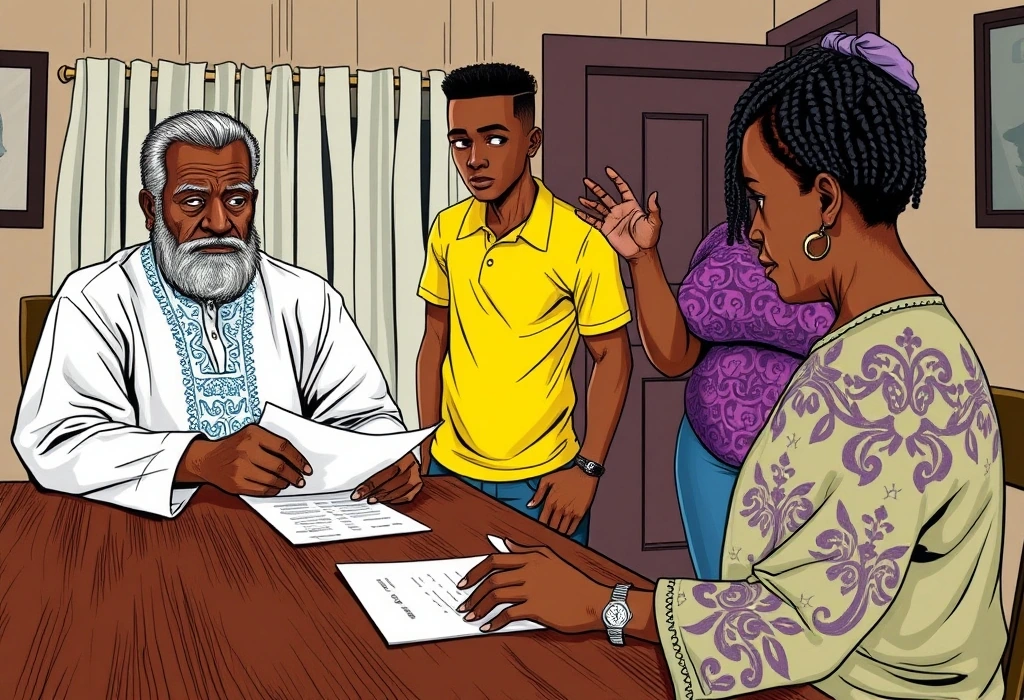
Mr. Adebayo questions the astronomical costs presented in the agent's glossy brochure.
Mr. Adebayo sat at the heavy mahogany dining table in their Enugu home, staring at a glossy, gold-embossed UK university brochure. Next to it lay a handwritten breakdown of school fees from Aunty Ronke's preferred visa connection in Lagos. The figures were terrifying, running into tens of thousands of pounds sterling. Kunle stood nearby, his hands nervously stuffed into his pockets, waiting for his father's final verdict. Mr. Adebayo adjusted his spectacles, his face a mask of deep suspicion. 'Kunle,' he said, tapping the paper, 'this agent is promising you the world, but this mathematics does not align with my civil service pension.'
Kunle explained that his friends were all heading to London, but Mr. Adebayo had heard too many stories of families selling ancestral land only for their children to return empty-handed. 'I am not paying for a dream that ends in deportation,' the retired civil servant declared. Aunty Ronke, who had dropped by with her usual boundless energy, leaned over the table, gesturing wildly. 'Ah, Brother! If you don't send him now, when? The agent said the UK slots are closing tomorrow!' But Mr. Adebayo was not a man to be rushed by artificial deadlines.
The Sceptical Search
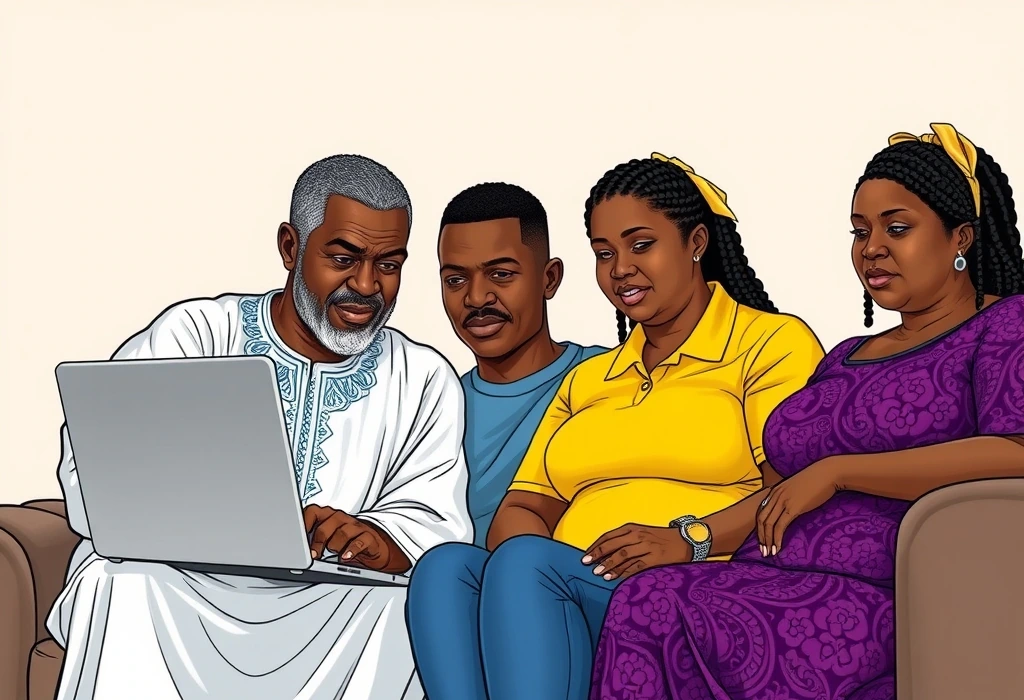
Father and son bypass the agent's claims to research official study routes online.
The next evening, the Adebayo living room became an active research centre. Mr. Adebayo had banned the Lagos agent from calling his phone and instead ordered Kunle to bring out his laptop. 'We are going to find the facts ourselves,' he declared. Kunle, wearing his yellow polo shirt, sat beside his father, typing furiously. Aunty Ronke sat on the sofa, clutching her handbag, still protesting that they were making simple things too difficult. 'Why go to Germany or Canada when everyone knows London?' she muttered.
'Because London is costing us what we do not have, Ronke,' Mr. Adebayo replied firmly. He pointed at the screen. Together, father and son began looking at alternative destinations that quietly offered better post-study stay-back opportunities. They discovered that Germany offered a highly predictable pathway, while Canada's policies were clearly laid out on official government portals. The relief in the room was palpable as Mr. Adebayo realised they didn't have to bankrupt themselves for a quality international degree.
The German Discovery
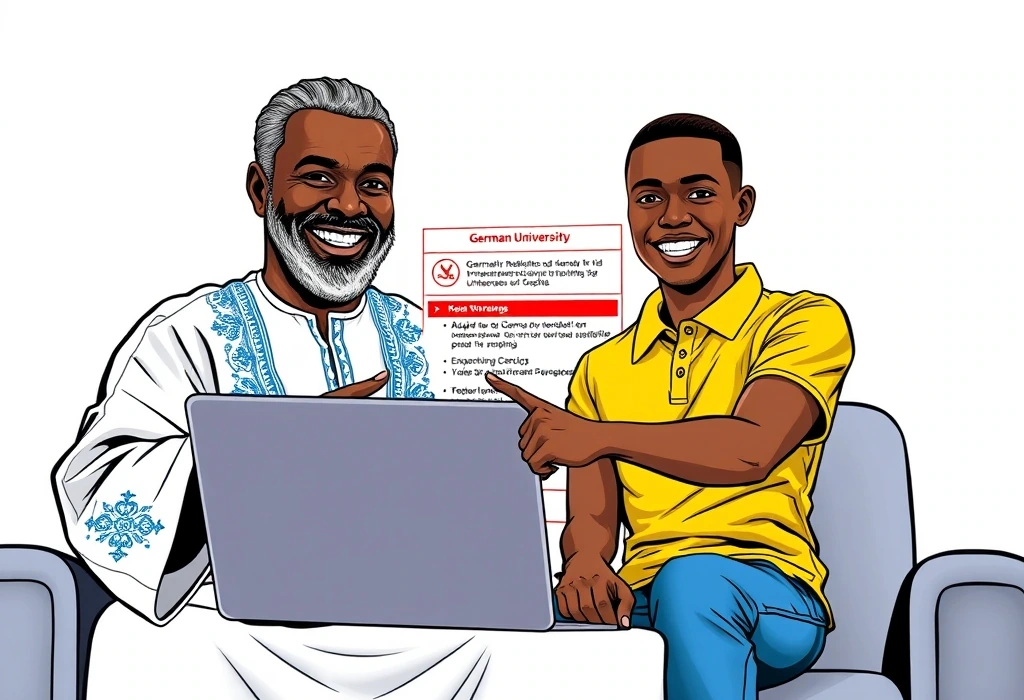
Kunle explains the tuition-free public university system and blocked account security to his father.
'Look at this, Papa,' Kunle said, pointing to an official German academic database. 'Public universities in Germany are completely tuition-free, even for international students!' Mr. Adebayo leaned in, his grey beard almost touching the screen. He was looking for the catch. 'Tuition-free? For free? In this world where even pure water is no longer cheap?' He made Kunle read the requirements aloud three times.
They learned about the blocked account system, which ensured that every Euro paid went directly toward Kunle’s own living expenses, not an agent's pocket. Even better, Germany offered an eighteen-month post-study work residence permit to let graduates find professional roles. Kunle’s eyes shone with excitement. 'And if I study engineering, which is STEM, they can extend it to twenty-four months!' Mr. Adebayo finally smiled, a genuine, relaxed expression. 'This is not a gamble,' he muttered, 'this is a structured plan.'
The Canadian Balance
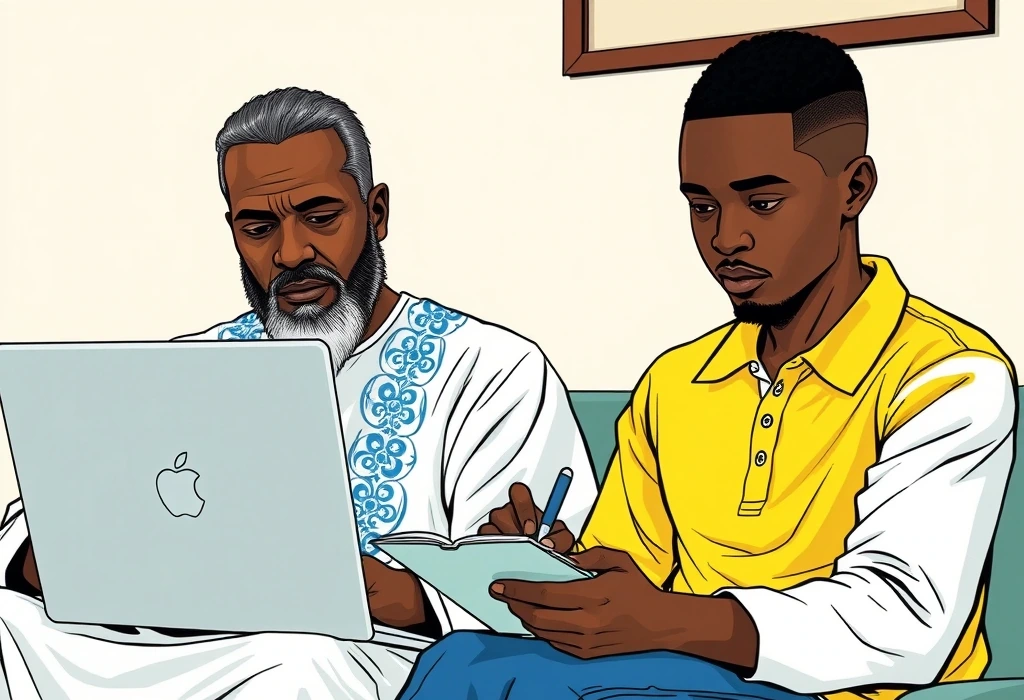
Comparing Canada's work permit processing times and fees against their family budget.
To ensure they had options, the family also investigated Canada. Mr. Adebayo wanted to compare the post-study visa processing times and fees. They found that Canada’s Post-Graduation Work Permit allowed graduates to work for up to three years if their programme was at least two years long. It cost two hundred and fifty-five Canadian dollars to apply and took an average of ninety-four days to process.
Kunle noted that Canada also allowed up to twenty hours of part-time work during studies, helping students manage their day-to-day costs. However, they read carefully about the selective eligibility rules introduced in twenty-twenty-six, which meant they had to choose the institution and programme with extreme care. 'You see?' Mr. Adebayo said, tapping Kunle’s shoulder. 'This is why we do our own homework. An agent would have just taken our money and registered you anywhere.'
A Direct Path Forward
The Adebayo family celebrates a clear, verified study path built on factual research.
A week later, the kitchen table was completely clear of the confusing, gold-embossed brochures. In their place were neat folders containing Kunle's official documents, his English test preparation materials, and direct application guides. Even Aunty Ronke had stopped forwarding WhatsApp broadcasts from unverified agents, seeing how calm and organised the household had become.
Mr. Adebayo stood up, adjusting his white kaftan, and placed a hand on his son's shoulder. 'We have saved millions of Naira in unnecessary tuition fees,' he said proudly. 'And more importantly, we know exactly where every single Kobo is going. You are going to get a world-class education, Kunle, and you will have a real, legal right to work when you finish.' Kunle looked up at his father, his smile wide and confident, ready to take on his future without the burden of debt.
What this story proves: Doing your own direct research using official portals reveals credible, affordable pathways that save millions of Naira and secure real work rights.
Canada: Navigating the 2026 PGWP and Study Permit Realities
Canada remains an exceptionally popular destination because of its structured immigration pathways. The Canadian Post-Graduation Work Permit (PGWP) allows graduates to work for up to three years if their programme was at least two years long. It costs CAN$255 to apply and averages 94 days to process. Students can also work up to 20 hours per week part-time during studies to support themselves. However, parents must note that in 2026, 2026 PGWP eligibility rules became more selective. Eligibility now depends heavily on the specific institution and programme you choose, making careful course selection absolute vital before paying any deposits.
Ireland's post-study work visa provides a direct path to multinational careers.
Hidden Low-Cost Gems Across Continental Europe
Beyond the major hubs, several European nations offer accredited, English-taught programmes at incredibly low rates. For instance, tuition fees in Greece are around 1,500 EUR per year for international students, which is combined with a very low cost of living. Similarly, Slovenia offers tuition around 5,000 EUR per year for non-EU students. If you want high-ranking universities, public universities in France charge relatively low fees for international students, with undergraduate fees starting at just €170 per year for EU citizens. These countries represent genuine, accredited paths to global careers without the crushing debt of traditional English-speaking destinations.
How to Plan Your Alternative Study Journey This Week
If you are ready to pivot away from the UK, the first step is preparing for your English proficiency requirements. Most European and Canadian universities require an IELTS score between 6.5 and 7.5, or a Duolingo score of 110 to 120. You should plan for 2 to 3 months for English test preparation and scheduling. Most importantly, do not rely on unverified agents who pressure you into quick payments. Protect your family's hard-earned tuition payments by using our one-afternoon agent verification checklist to ensure your study plans are safe, legal, and verified.
Frequently asked questions
Can Nigerian students really study for free in Germany?
Yes. Public universities in Germany do not charge tuition fees to international students, regardless of nationality. However, students must demonstrate sufficient funds through a blocked account to cover their living expenses and must have health insurance.
What is the Stamp 1G visa in Ireland and who qualifies?
The Stamp 1G visa is Ireland’s post-study work option under the Third Level Graduate Programme. It allows non-EU graduates of accredited bachelor's, master's, or PhD programmes to remain for up to two years. To qualify, you must apply within six months of graduation and find a role paying at least €30,000 per year for at least 20 hours per week.
How long does it take to get a Canada Post-Graduation Work Permit (PGWP)?
Applying for Canada's Post-Graduation Work Permit costs CAD 255 and takes an average of 94 days to process. The permit allows graduates of designated learning institutions to work for up to three years, depending on the length of their study programme.
Researched and drafted with AI against the sources listed above, then published by Dhub Education. Policies and costs change quickly — always confirm details with the university or the relevant government body before you act.